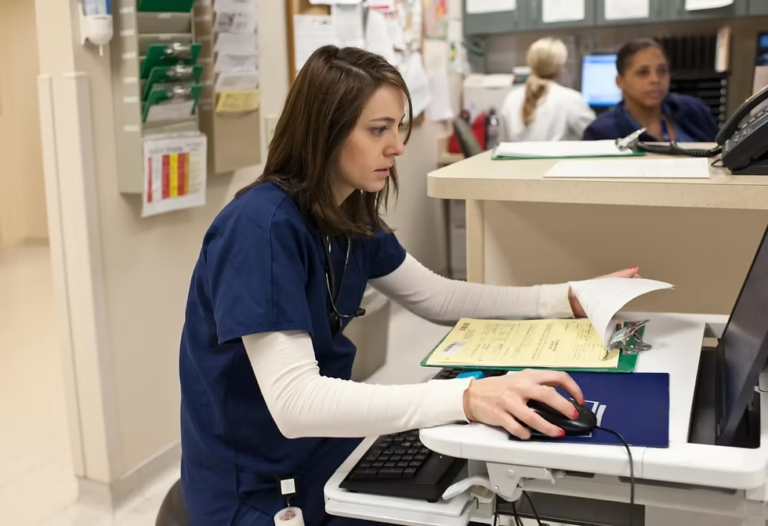
AI in healthcare careers is no longer a future concept. It is actively reshaping how medical and dental professionals work, interact with patients, and define value in their roles.
Across healthcare settings, a clear shift is underway. Work that once centered on documentation, coding, and scheduling is moving toward oversight and interpretation. At the same time, patient interaction is becoming more central to the day-to-day role.
This change is not removing responsibility. Instead, it is redefining where time and attention are spent.
AI in Healthcare Careers: From Data Entry to Data Oversight
For years, administrative and clinical teams have carried the burden of repetitive tasks. Documentation, billing, and scheduling often consumed a large portion of the workday.
Today, that structure is changing.
Automation tools now handle many of these processes. As a result, professionals are shifting from entering information to validating and managing it. This introduces a different kind of responsibility—one that requires attention to accuracy, context, and outcomes.
The work remains. The function evolves.
How Administrative Roles Are Evolving in AI in Healthcare Careers
Administrative positions are moving beyond task execution into more patient-focused and analytical responsibilities.
Intelligent Scheduling and Workflow Management
Scheduling systems now analyze patient demand, provider availability, and historical patterns. These tools reduce gaps and improve overall flow.
Administrative professionals oversee system recommendations rather than building schedules manually.
Revenue Cycle Oversight
Coding and billing processes are also changing. AI-supported tools review documentation and assign codes in real time.
This shifts the role from manual entry to oversight, where professionals focus on exceptions, compliance, and accuracy.
A More Focused Patient Intake Experience
Routine communication is increasingly automated. Patients complete forms, receive instructions, and ask basic questions before arrival.
As a result, front office teams can focus on higher-value interactions that improve the patient experience.
Clinical Work Is Becoming More Focused in AI in Healthcare Careers
Clinical roles continue to rely on skill and judgment. However, the way information is captured and used is evolving.
Ambient Documentation and Time Reclaimed
Speech recognition tools now capture clinical notes during patient visits. This reduces after-hours documentation and allows providers to stay engaged during the encounter.
Diagnostic Support as a Second Layer
AI-assisted imaging tools highlight patterns in X-rays and scans. These systems provide additional insight, but interpretation remains the responsibility of the clinician.
Earlier Awareness Through Predictive Insight
Some systems identify risk indicators before symptoms fully appear. This allows clinical teams to respond earlier and improve outcomes.
Will AI Replace Jobs in Healthcare Careers?
The question continues to surface as technology becomes more integrated into daily workflows.
AI performs well in structured environments. However, healthcare requires judgment, communication, and adaptability.
For that reason, high-touch roles remain in demand.
Patient-facing positions continue to grow because they depend on human interaction. Most systems follow a “human-in-the-loop” model, where technology provides input and professionals make final decisions.
How to Adapt to AI in Healthcare Careers
Adapting to AI in healthcare careers requires a shift in both mindset and skill development.
Technical Awareness
Professionals benefit from understanding how to interpret AI-generated outputs, including diagnostics and coding recommendations.
Human-Centered Skills
Communication and empathy are becoming more important. As routine work decreases, the quality of human interaction becomes more visible.
Governance and Accountability
There is also a growing need to understand data privacy and ethical considerations. Healthcare professionals remain responsible for how information is used and applied.
The Bottom Line
AI in healthcare careers is not replacing the professional. It is reducing the administrative burden that limits time with patients.
The shift taking place in 2026 reflects a broader change in how work is structured. Technology handles background processes, while professionals focus on care, interpretation, and outcomes.
The roles remain. The work is being redefined.